

Paver Sealing in Des Plaines, IL: Cleaning, Joint Restoration, and Sealing
3D Brick Paving Co. restores and protects paver surfaces across Des Plaines and the Chicago suburbs with professional cleaning, joint stabilization, and sealing built around Northern Illinois weather.
The D’Aiello family has worked on brick paver patios, driveways, walkways, stoops, natural stone surfaces, and retaining walls throughout Cook, DuPage, and Lake County for more than 50 years. Gaetano D’Aiello founded the company in 1972; Mike and Frank D’Aiello joined in 1981. The company still operates from 1000 Lee Street in Des Plaines.
Cleaning and sealing isn’t a cosmetic wash in this climate. It’s surface protection, joint defense, and water control.
Why Pavers Fail in the Chicago Climate
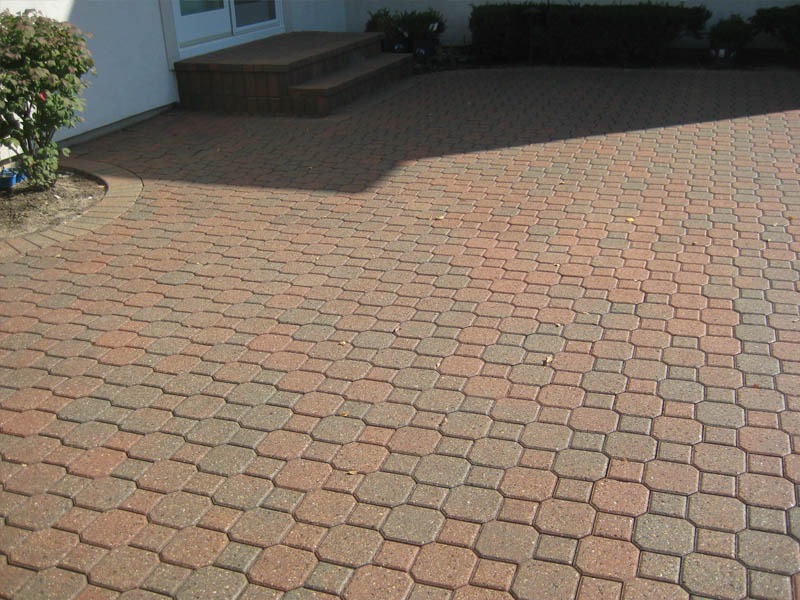
Des Plaines pavers face a harsh annual cycle: summer UV, heavy seasonal rain, winter snow, de-icing salts, and rapid freeze-thaw movement.
Concrete pavers and many natural stones contain open capillary pores. When those pores absorb water, the surface carries moisture below the visible face. During freeze-thaw cycles, trapped water expands roughly 9% as it freezes, creating hydrostatic pressure that opens micro-fissures, loosens surface paste, and causes spalling.
The damage doesn’t stop at the paver face. Unsealed, unstable joints collect moss, algae, weeds, mildew, and mold, all of which hold moisture inside the joint network. Weed roots displace sand, and insects can hollow out small channels. Once the joint loses friction, the pavers lose lateral support. That’s when a patio starts shifting, a driveway develops low spots, or a walkway starts rocking underfoot.
A sealer protects the surface, but joint restoration underneath it decides how long the work actually holds.
What Cleaning and Sealing Actually Fixes
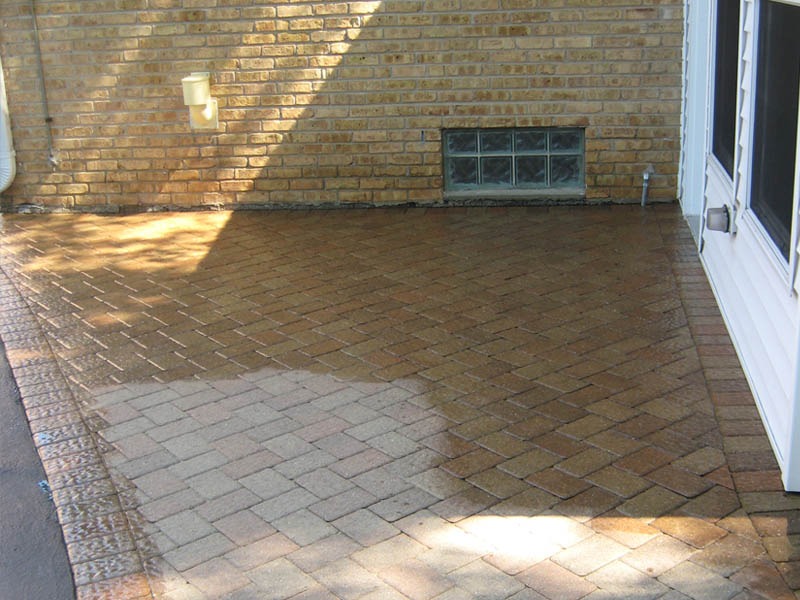
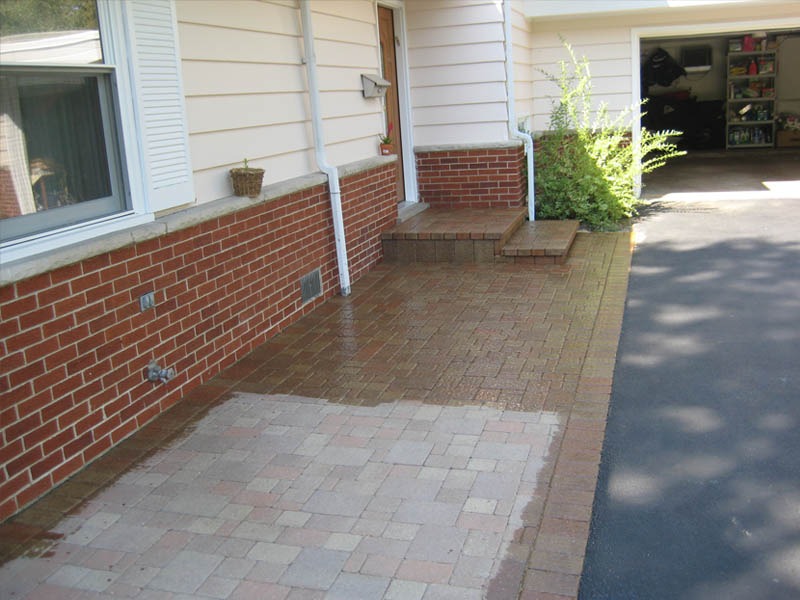
Most failed paver surfaces don’t need one fix. They need a sequence: organic treatment, stain treatment, efflorescence control, controlled washing, joint refill, and a sealer chosen for the material and exposure.
| Failure Mode | Cause | Restoration Response |
|---|---|---|
| Faded paver color | UV exposure, surface wear | Cleaning, color refresh via sealer selection |
| White haze | Calcium carbonate efflorescence | Buffered acid treatment and full rinse |
| Weed-filled joints | Organic buildup, failed sand | Joint purge, polymeric sand refill |
| Oil and grease stains | Vehicle fluids, cooking grease | Alkaline emulsifying degreaser |
| Spalling | Freeze-thaw expansion, de-icing salt | Breathable sealer, water control |
| Low spots and movement | Sand loss, base migration | Joint repair plus reset evaluation |
What Cleaning and Sealing Actually Fixes
Most failed paver surfaces don’t need one fix. They need a sequence: organic treatment, stain treatment, efflorescence control, controlled washing, joint refill, and a sealer chosen for the material and exposure.
Failure Mode Cause Restoration Response |
Failure Mode Cause Restoration Response |
Failure Mode Cause Restoration Response |
Failure Mode Cause Restoration Response |
Failure Mode Cause Restoration Response |
Failure Mode Cause Restoration Response |
The Restoration Process
Biological and organic neutralization
first. Moss, algae, mildew, and lichens hold water and release organic acids that create the damp joint conditions weeds and insects need. The standard treatment uses diluted sodium hypochlorite, typically 1 part bleach to 3 parts water, or an enzymatic treatment to kill spores before washing. Oil, grease, and vehicle fluid stains need an alkaline emulsifying degreaser instead, since it saponifies and lifts lipids out of the paver pores.
Efflorescence removal
comes next if white haze is present. It forms when free calcium hydroxide in cement reacts with carbon dioxide to form calcium carbonate (CaCO₃). Sealing over efflorescence traps it under the film and creates a cloudy finish that usually needs chemical stripping to fix. The correct response is a buffered mild acid, such as diluted hydrochloric or phosphoric acid, which converts the insoluble carbonate into soluble salts that rinse away. Get the acid strength or dwell time wrong and the paver either etches or the deposit stays put.
Calibrated hydro-cleaning
finishes the prep work. Pressure washing pavers isn’t the same as blasting a concrete driveway: the standard range is 600 to 2,000 psi with rotary flat-surface equipment, enough to lift failed joint sand and embedded dirt without cutting the paver face or undermining the setting bed. An oblique spray angle purges the joint line without digging below the paver. Straight downward pressure can strip too much support, especially on older installs where the bedding layer has already softened.
Joint Restoration: The Part Most Homeowners Don't See
The sealer gets the attention because it changes how the surface looks. The joints do the structural work.
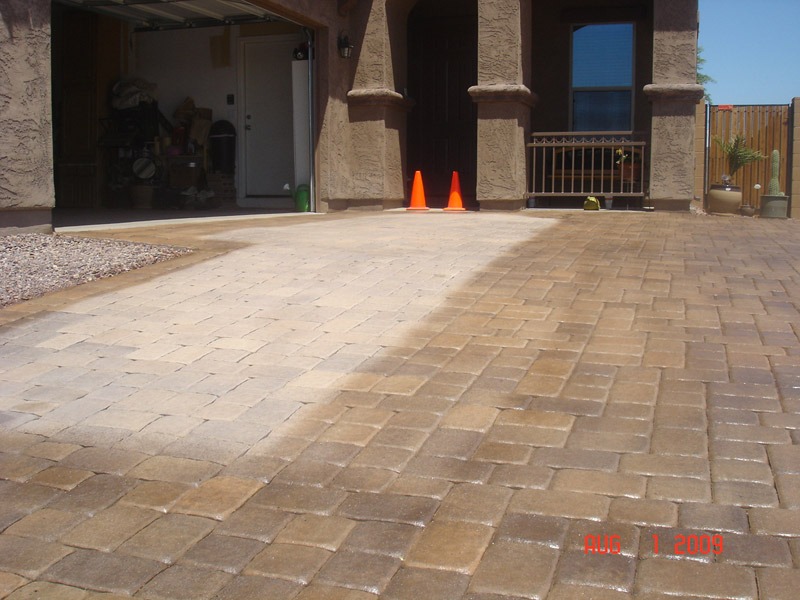
Interlocking pavers depend on friction between adjacent units. Joint sand fills the gaps, transfers force, and limits lateral movement. Once joints empty out, pavers shift independently: driveways separate under tire movement, patios develop rocking corners, walkways form trip points.
Joint restoration runs through removing failed sand, cleaning the joint cavity, refilling with polymeric sand, compacting the surface so the sand settles deeper, activating it with water, then sealing once prep is done. Water-based sealers work especially well here because the polymer emulsion binds sand grains into a more stable matrix while still letting vapor move through the surface.
Joint Restoration: The Part Most Homeowners Don't See
The sealer gets the attention because it changes how the surface looks. The joints do the structural work.
Interlocking pavers depend on friction between adjacent units. Joint sand fills the gaps, transfers force, and limits lateral movement. Once joints empty out, pavers shift independently: driveways separate under tire movement, patios develop rocking corners, walkways form trip points.
Joint restoration runs through removing failed sand, cleaning the joint cavity, refilling with polymeric sand, compacting the surface so the sand settles deeper, activating it with water, then sealing once prep is done. Water-based sealers work especially well here because the polymer emulsion binds sand grains into a more stable matrix while still letting vapor move through the surface.
Water-Based vs. Solvent-Based Sealers
The right sealer depends on the paver, the joint condition, moisture exposure, and the finish you want.
Water-based sealers are usually the safer default for this climate because they breathe, letting water vapor escape from below the surface during freeze-thaw cycles. That cuts the risk of trapped moisture, clouding, and film failure. Solvent-based sealers give a richer wet-look finish but need exact conditions: the surface must be fully dry before application, or trapped moisture causes blushing, an opaque white veil under the coating.
| Sealer Type | Best Use | Advantages | Risks |
|---|---|---|---|
| Water-Based Polymer Emulsion | Patios, walkways, driveways, most maintenance cycles | Breathable, UV stable, matte or satin finish, binds joint sand well | Rain before polymerization weakens the finish |
| Solvent-Based Acrylic/Polyurethane | High-gloss, deep wet-look finishes | Richer color, longer average service life if applied correctly | Needs 24-48 hours dry substrate, blushing risk, UV yellowing risk |
Water-based sealers average 2 to 3 years of service life; solvent-based sealers average 4 to 5 years when applied correctly. Longevity depends on sun exposure, traffic, salt exposure, surface porosity, and prior coating history. For most Des Plaines homes, a matte or satin water-based sealer gives the better balance of protection without trapping moisture under the film.
Joint Restoration: The Part Most Homeowners Don't See
The sealer gets the attention because it changes how the surface looks. The joints do the structural work.
Interlocking pavers depend on friction between adjacent units. Joint sand fills the gaps, transfers force, and limits lateral movement. Once joints empty out, pavers shift independently: driveways separate under tire movement, patios develop rocking corners, walkways form trip points.
Joint restoration runs through removing failed sand, cleaning the joint cavity, refilling with polymeric sand, compacting the surface so the sand settles deeper, activating it with water, then sealing once prep is done. Water-based sealers work especially well here because the polymer emulsion binds sand grains into a more stable matrix while still letting vapor move through the surface.
Water-Based vs. Solvent-Based Sealers
The right sealer depends on the paver, the joint condition, moisture exposure, and the finish you want.
Water-based sealers are usually the safer default for this climate because they breathe, letting water vapor escape from below the surface during freeze-thaw cycles. That cuts the risk of trapped moisture, clouding, and film failure. Solvent-based sealers give a richer wet-look finish but need exact conditions: the surface must be fully dry before application, or trapped moisture causes blushing, an opaque white veil under the coating.
Sealer Type Best Use Advantages Risks |
Sealer Type Best Use Advantages Risks |
Water-based sealers average 2 to 3 years of service life; solvent-based sealers average 4 to 5 years when applied correctly. Longevity depends on sun exposure, traffic, salt exposure, surface porosity, and prior coating history. For most Des Plaines homes, a matte or satin water-based sealer gives the better balance of protection without trapping moisture under the film.
Waterproofing Near the Foundation
Bad restoration work can create bigger problems than dirty pavers.
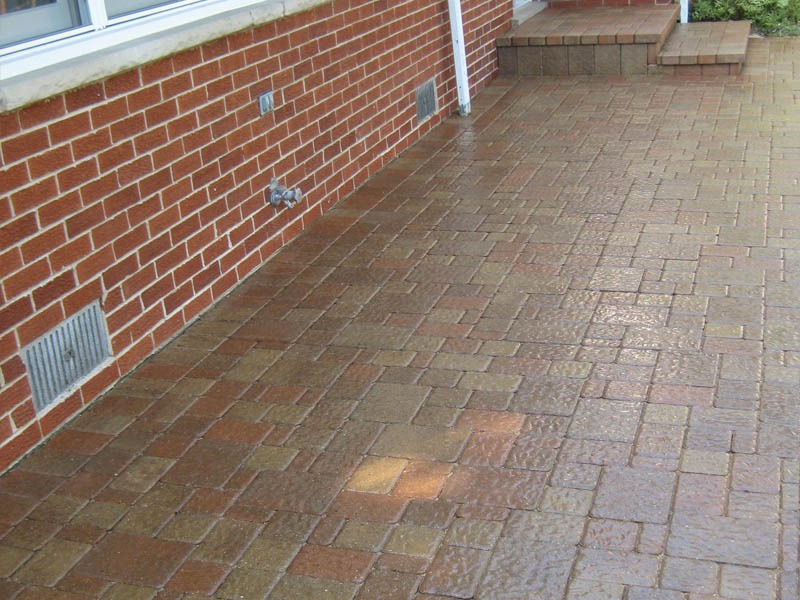
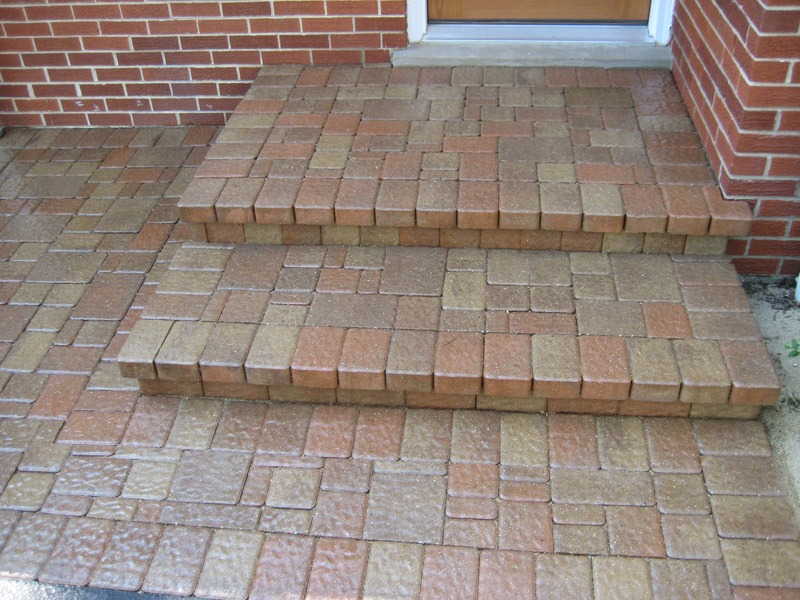
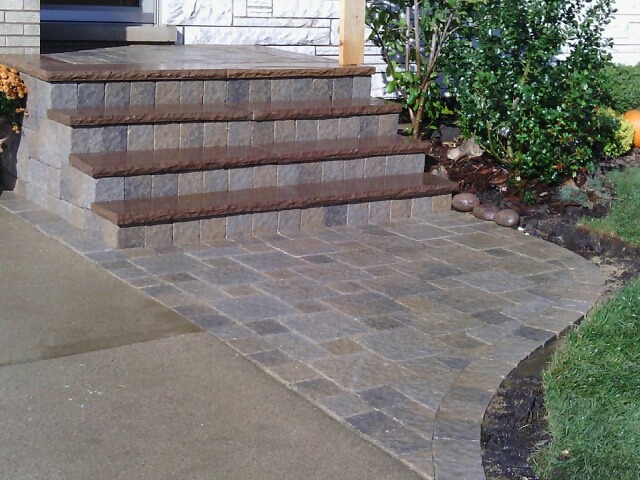
Raised paver steps, stoops, and stair assemblies built against a residential wall need separation from the foundation. If wet base material sits against porous brick or masonry, capillary migration can draw moisture into the wall, and freezing weather turns that moisture into spalling and crumbling brick. A self-adhering waterproofing membrane at the paver-to-foundation interface is the correct fix wherever a paver structure meets a residential wall.
Drainage slope needs the same attention. A sealed patio that still holds water will keep failing regardless of the sealer. Surfaces should shed water by gravity, away from the foundation and away from low entry thresholds. On Des Plaines projects where added hardscape area changes runoff, a dry well may be required to manage stormwater. Sealer protects a correct system. It doesn’t fix bad pitch or missing waterproofing.
ASTM and ICPI Standards That Decide If Sealing Will Even Work
A sealer can’t rescue a structurally deficient paver. The paver needs enough density and freeze-thaw durability to accept long-term treatment in the first place.
| Parameter | Standard | Minimum Requirement | Why It Matters |
|---|---|---|---|
| Compressive strength | ASTM C140 | 8,000 psi / 55 MPa | Resists crushing and surface cracking under load |
| Water absorption | ASTM C140 | 5% average, 7% maximum | Limits water available for freeze-thaw damage |
| Freeze-thaw mass loss | ASTM C1645 | 225 g/m² after 28 cycles | Measures resistance to salt and freeze-related surface loss |
| Bedding sand thickness | ICPI standard | 1 in nominal, 1.5 in maximum | Keeps the system flat, limits deformation |
If the paver is too soft, too porous, already spalled, or delaminating, sealing improves appearance for a short stretch and nothing more.
ASTM and ICPI Standards That Decide If Sealing Will Even Work
A sealer can’t rescue a structurally deficient paver. The paver needs enough density and freeze-thaw durability to accept long-term treatment in the first place.
Parameter Standard Minimum Requirement Why It Matters |
Parameter Standard Minimum Requirement Why It Matters |
Parameter Standard Minimum Requirement Why It Matters |
Parameter Standard Minimum Requirement Why It Matters |
If the paver is too soft, too porous, already spalled, or delaminating, sealing improves appearance for a short stretch and nothing more.
Cost Guide for Des Plaines and the Chicago Suburbs
Professional cleaning, polymeric sand, and sealing generally runs $1.25 to $3.50 per square foot for standard service. Porous natural stone like travertine, sandstone, or limestone can reach $4.00 per square foot since it absorbs more product. Failed old coatings, peeling sealer, heavy weed growth, or chemical stripping add $1.50 to $3.00 per square foot in extra labor.
| Project Type | Approx. Area | Standard Service | Heavy Restoration |
|---|---|---|---|
| Small stoop or landing | 48 sq. ft. | $60 to $170 | $150 to $300 |
| Narrow walkway | 120 sq. ft. | $150 to $420 | $350 to $600 |
| Medium patio | 225 sq. ft. | $280 to $790 | $650 to $1,100 |
| Double driveway | 1,500 sq. ft. | $1,875 to $4,425 | $3,500 to $5,500 |
Final pricing depends on surface condition, material porosity, joint depth, weed growth, access, drainage problems, old coating failure, and whether pavers need resetting first. A cheap wash-and-seal job usually skips the expensive parts: stripping failed coatings, removing contaminated sand, correcting low joints, and waiting for the right moisture conditions before sealing.
Contact 3D Brick Paving Co.
We serve Des Plaines, Unincorporated Maine Township, and surrounding northern Chicago suburbs. Consultations include a site visit, fire clearance and setback review, drainage assessment, and a 3D design rendering at no charge.