

Arlington Heights Brick Paving Built for Prairie Clay, Freeze-Thaw Pressure, and Long-Term Drainage
Arlington Heights paver work fails from the ground up when the base gets treated like decoration instead of structure. Northern Illinois prairie clay holds water. Winter freeze cycles turn that trapped moisture into expansion pressure. Spring thaw leaves softened soil, voids, settlement, sunken joints, and uneven pavers.
3D Brick Paving Co. designs brick patios, sidewalks, driveways, stoops, and outdoor living spaces for the way Arlington Heights soil actually behaves. Every project starts with excavation depth, drainage pitch, aggregate selection, compaction, and permit-ready planning before the first paver goes down.
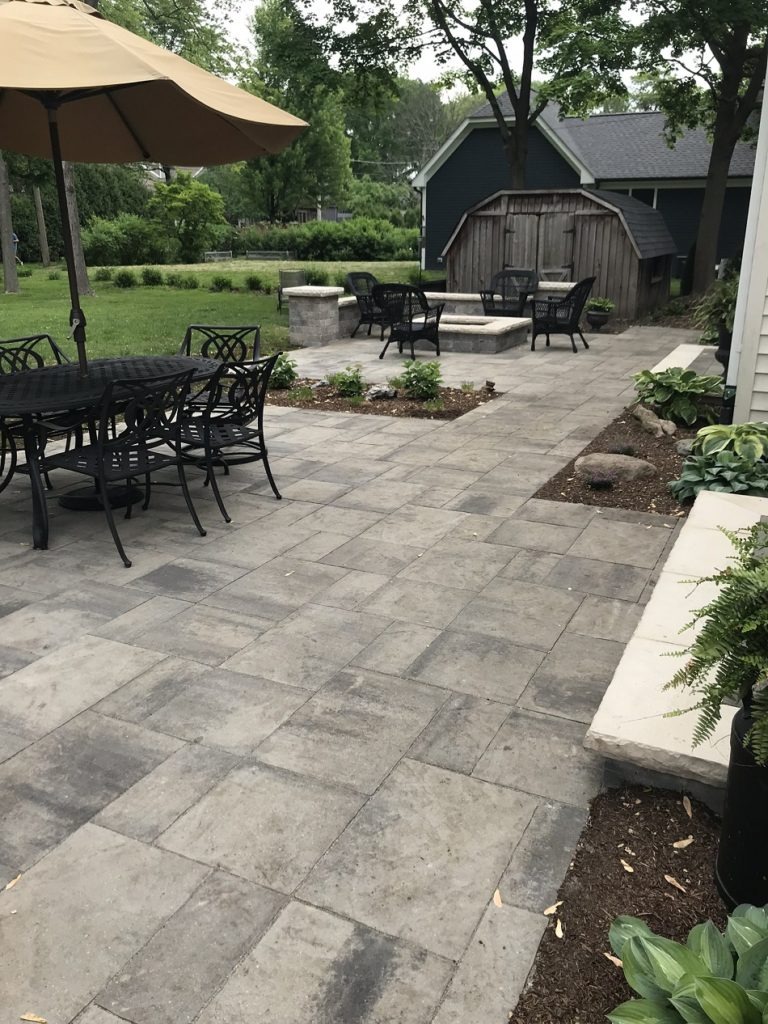
A recent Arlington Heights project shows the standard: crews removed old concrete, installed a new patio and sidewalk in 4 days, and rebuilt the surface with Unilock Umbriano Winter Marvel pavers and an 8×4 Series 3000 Onyx Black border. The published project cost was $20,000.
Brick Paving Services in Arlington Heights, IL
Brick Paver Patios
A patio in Arlington Heights needs more than a clean surface pattern. It needs a base that sheds water away from the home and resists clay movement below the surface.
Our patio installations account for:
- 42-inch frost depth conditions when stoops, stairs, and load-bearing edges are involved
- Minimum 4-inch compacted CA-6 aggregate base where flatwork standards apply
- No pea gravel or rounded stone under load-bearing paving areas
- Pitch away from the foundation to reduce water pressure against the home
- Top-of-slab and foundation clearance so the finished patio doesn’t trap water at the masonry line
- Polymeric joint stabilization to reduce washout, weed growth, and lateral paver movement
Brick Driveways
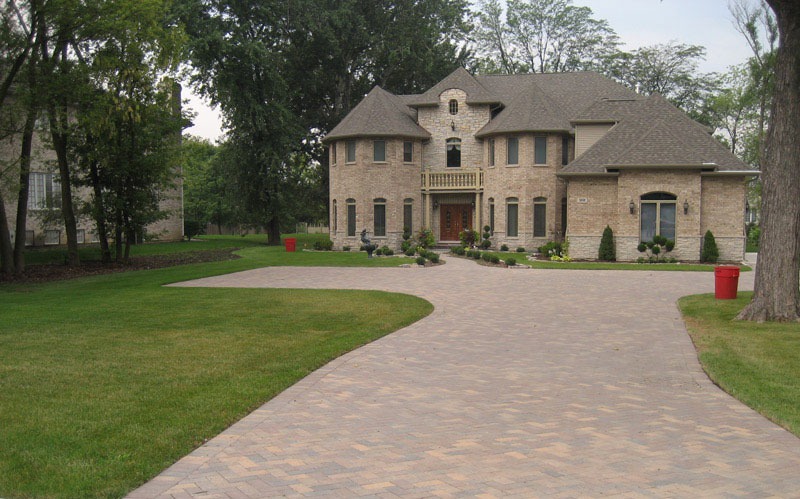
Driveways carry turning loads, braking loads, vehicle weight, and freeze-thaw movement. A driveway installed over weak aggregate can rut, spread, and settle even when the paver surface looks clean on day one.
For Arlington Heights driveways, we plan around:
- Driveway dimensions and setbacks shown on the plat or site plan
- Drainage direction toward the rear yard or street where required
- CA-6 aggregate compaction before surface installation
- Public sidewalk and driveway approach conditions
- Decorative paver waiver review when brick pavers enter the public right-of-way
- Front yard impervious coverage limitations during design planning
Brick Sidewalks and Walkways
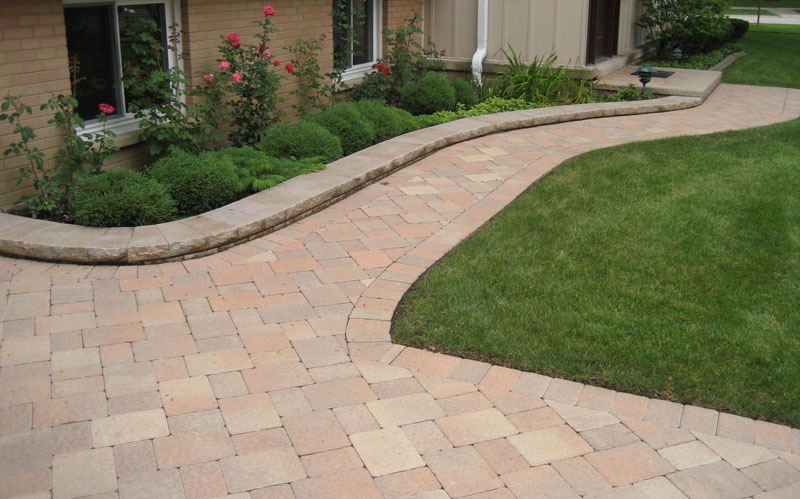
Walkways often fail where downspouts, sump discharge, and shaded soil create constant moisture. Our walkway work focuses on drainage first, then pattern, border, and finish.
A properly built Arlington Heights walkway should have:
- A stable excavated subgrade
- Angular compacted aggregate
- Controlled surface pitch
- Tight edge restraint
- Joint material matched to traffic and water exposure
- Transitions that don’t create trip points at steps, stoops, or driveway edges
Recent Arlington Heights Project: Patio and Sidewalk Replacement
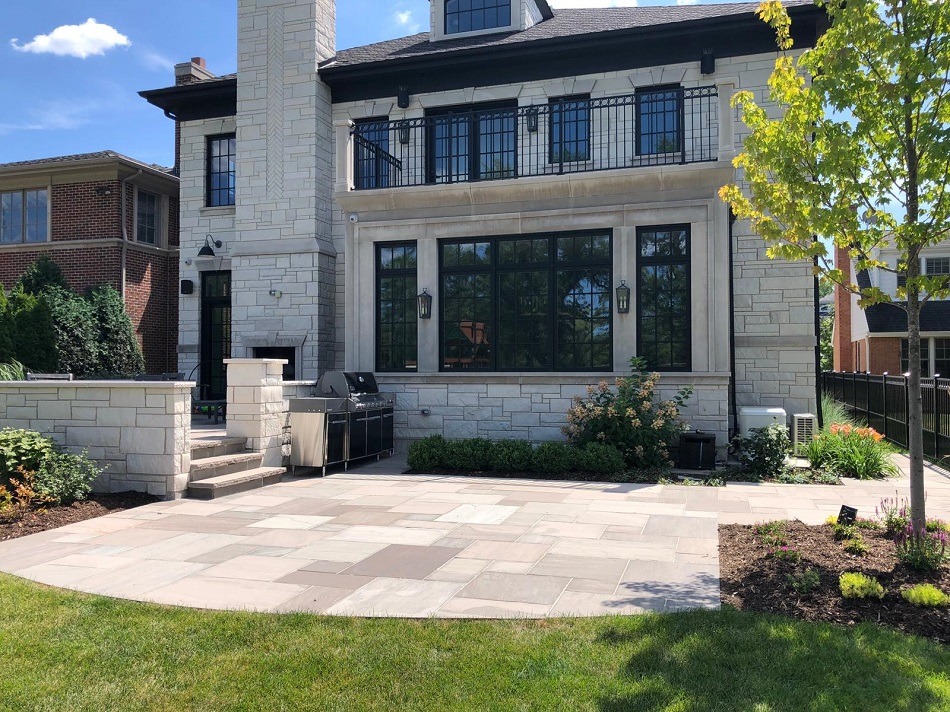
3D Brick Paving Co. completed a backyard upgrade in Arlington Heights that replaced old concrete with a new patio and sidewalk system.
Detail | Arlington Heights Project |
Location | Arlington Heights, IL |
Duration | 4 days |
Scope | Removed old concrete and installed a new patio and sidewalk |
Materials | Unilock Umbriano Winter Marvel pavers |
Border | 8×4 Series 3000 Onyx Black |
Published cost | $20,000 |
This is the kind of local proof a page like this should run on: specific, visual, and tied to Arlington Heights instead of a generic Chicagoland claim.
Why CA-6 Aggregate Matters Under Arlington Heights Pavers
Pea gravel looks clean in a wheelbarrow, but it performs poorly under hardscape loads. The rounded stones move against each other under pressure, and that movement creates surface settlement, paver rocking, edge spread, and joint failure.
CA-6 crushed aggregate performs differently. Its angular particles lock together under mechanical compaction, and the fines fill voids between larger stone pieces to create a dense base that resists lateral movement.
For Arlington Heights hardscapes, that’s the difference between a patio that ages evenly and one that starts showing low spots after a few freeze-thaw cycles.
Drainage Is Structural, Not Cosmetic
Water is the main stressor behind most paver failures in Northern Illinois. It weakens clay, washes out joint sand, creates ice lenses in winter, and adds pressure against foundation masonry.
Our drainage planning includes:
- Pitching paved surfaces away from the house
- Reviewing downspout and sump discharge locations
- Checking proposed grade against adjacent properties
- Keeping finished surfaces below the top of the existing foundation
- Building surface flow into the design before selecting paver color or border pattern
- Recommending drains, dry wells, or other water-management details when the lot needs them
A good patio should look level to the eye. It should never be dead flat.
Arlington Heights Permit-Ready Planning
Arlington Heights requires permit applications through the Civic Access Portal for applicable construction projects. Patio, driveway, and flatwork planning needs to be documented with the right site information before work begins.
For larger or regulated scopes, the project file may need:
- Current plat of survey or site plan
- Existing and proposed hardscape dimensions
- Current and proposed drainage patterns
- Downspout and sump discharge direction
- Driveway width and setback information
- Utility easement review
- Pre-pour/base inspection readiness
- Final inspection readiness
Before excavation, we request JULIE 811 utility locating so crews know what’s underground before they cut into the site.
Engineering vs. Corner-Cutting
A hardscape can look finished and still be wrong underneath.
One regional paving failure illustrates the cost of skipping a step: a masonry stair and paver system installed against a home without a waterproof capillary break at the building-hardscape interface. Years later, trapped moisture migrated into the home’s brick wall. Freeze-thaw damage and mortar breakdown led to an estimated $27,000 in masonry repair exposure, on a project that had cost roughly $50,000 to build.
That failure came from one omission nobody could see at handoff.
Our Arlington Heights installation planning treats those hidden details as part of the build, not extras:
- Waterproof separation where masonry, stoops, or steps meet the home
- Foundation clearance checks before final elevations are set
- Drainage pitch verified before paver installation
- CA-6 base compaction before surface work
- No pea gravel under structural flatwork
- Joint and sealer chemistry selected for moisture conditions
- Inspection-ready base preparation before final finishing
The paver pattern is what homeowners see. The base, pitch, and moisture control are what keep the investment from failing in year three.
Cleaning, Sealing, and Joint Restoration in Arlington Heights
Older paver surfaces can often get restored without full replacement if the base is stable. The right maintenance plan depends on joint loss, staining, efflorescence, biological growth, and previous sealer failure.
Project Type | Standard Maintenance | Heavy Restoration |
Stoop or small landing, approx. 48 sq. ft. | $60 to $170 | $150 to $300 |
Narrow walkway, approx. 120 sq. ft. | $150 to $420 | $350 to $600 |
Medium patio, approx. 225 sq. ft. | $280 to $790 | $650 to $1,100 |
Double driveway, approx. 1,500 sq. ft. | $1,875 to $4,425 | $3,500 to $5,500 |
Standard maintenance can include washing, joint stabilization, and basic sealing. Heavy restoration may involve old sealer stripping, efflorescence treatment, biological removal, paver lifting, resetting, or base correction.
Final pricing comes after a site assessment, since drainage failure, old solvent sealer, and base settlement all change the scope.
Older paver surfaces can often get restored without full replacement if the base is stable. The right maintenance plan depends on joint loss, staining, efflorescence, biological growth, and previous sealer failure.
Standard maintenance can include washing, joint stabilization, and basic sealing. Heavy restoration may involve old sealer stripping, efflorescence treatment, biological removal, paver lifting, resetting, or base correction.
|
Project Type Stoop or small landing, approx. 48 sq. ft. Standard Maintenance $60 to $170 Heavy Restoration $150 to $300 |
|
Project Type Narrow walkway, approx. 120 sq. ft. Standard Maintenance $150 to $420 Heavy Restoration $350 to $600 |
|
Project Type Medium patio, approx. 225 sq. ft. Standard Maintenance $280 to $790 Heavy Restoration $650 to $1,100 |
|
Project Type Double driveway, approx. 1,500 sq. ft. Standard Maintenance $1,875 to $4,425 Heavy Restoration $3,500 to $5,500 |
Final pricing comes after a site assessment, since drainage failure, old solvent sealer, and base settlement all change the scope.
Water-Based vs. Solvent-Based Sealer
Not every paver surface should get the same sealer.
Water-Based Polymer Emulsion works best for many Arlington Heights patios, walkways, and frost-exposed surfaces. It leaves a breathable finish, allows vapor movement through the paver system, and reduces trapped moisture pressure, which suits freeze-thaw exposure well. Typical service life runs 2 to 3 years.
Solvent-Based Acrylic or Polyurethane works best when a homeowner wants a deeper wet-look finish and the surface is dry enough for application. It gives richer color enhancement, higher sheen potential, and a longer wear window in the right conditions, typically 4 to 5 years, but it requires low residual moisture before application.
If solvent sealer traps moisture, the finish can blush, haze, or turn cloudy. That’s why we test surface moisture before sealing.
Why Arlington Heights Homeowners Choose 3D Brick Paving Co.
3D Brick Paving Co. has served Chicagoland since 1972 and operates out of nearby Des Plaines. The company is a Unilock Authorized Contractor with ICPI-certified staff. Most products carry a manufacturer lifetime warranty backed by a 5-year unconditional labor guarantee.
That track record matters in Arlington Heights because the best-looking paver project still has to survive:
- Heavy clay soil
- Freeze-thaw movement
- Drainage review
- Foundation protection
- Driveway load stress
- Inspection requirements
- Long-term joint and sealer maintenance
Frequently Asked Questions
Most flatwork needs a minimum 4-inch compacted CA-6 aggregate base. Stoops, stairs, and other load-bearing edges that interact with frost depth often need excavation closer to 42 inches.
Permit applications run through the Civic Access Portal. Whether a specific patio or driveway project needs one depends on size, location, and whether it touches the public right-of-way, so check with the village or with your contractor before starting excavation.
Prairie clay holds water. When that water freezes, it expands and pushes against the base. When it thaws, the softened clay leaves voids underneath the pavers, which leads to settlement, sunken joints, and uneven surfaces over time.
No. Pea gravel is rounded, and rounded stone shifts under load instead of locking in place. CA-6 crushed aggregate has angular particles that compact into a dense, stable base.
A typical patio and sidewalk replacement runs around 4 days, depending on size, old material removal, drainage work, and weather. Larger driveways or projects with extensive base correction take longer.
Water-based polymer sealer breathes, which helps it handle freeze-thaw exposure, and lasts about 2 to 3 years. Solvent-based acrylic or polyurethane sealer gives a deeper wet-look finish and lasts 4 to 5 years, but it needs a dry surface to go on correctly.
Standard maintenance ranges from about $60 for a small stoop to $4,425 for a large double driveway. Heavy restoration, which can include sealer stripping and base correction, runs from about $150 to $5,500 depending on size and condition.
Water is the main cause of paver failure in Northern Illinois. It weakens clay, washes out joint sand, forms ice lenses, and pressures foundation masonry. A patio can look perfect on day one and still fail within a few years if the drainage pitch is wrong.
Moisture can migrate into the home’s brick wall over time. One regional case tied to this exact omission led to an estimated $27,000 in masonry repair exposure on a project that originally cost about $50,000 to build.
Yes. The company installs new patios, driveways, sidewalks, and stoops, and also restores older paver surfaces through cleaning, joint stabilization, and resealing when the existing base is still sound.
Schedule an Arlington Heights Brick Paving Assessment
Start with a site assessment before choosing paver colors, borders, or patterns.
3D Brick Paving Co. will review your existing surface, drainage direction, foundation clearance, access, base condition, and permit considerations before giving a project recommendation.
Call 847-297-7966 or request a free quote for brick patios, driveways, sidewalks, stoops, cleaning, sealing, and paver restoration in Arlington Heights, IL.